
Dual Protection for the SDV Era: iST’s Integrated Functional Safety & Cybersecurity Solutions Safeguard Your Entry into Global Automotive Supply Chains
In the era of the Software-Defined Vehicle (SDV), the challenges faced by automotive electronics extend far beyond “hardware failures” to include sophisticated “cyberattacks.” To successfully enter the supply chains of global automakers, enterprises must master two core technical pillars: ISO 26262 (Functional Safety) and ISO 21434 (Cybersecurity). Only through this dual approach can products guarantee stable and safe operations under extreme environmental conditions.
Dual Insurance for Automotive Electronics: Safety & Security
- ISO 26262 (Functional Safety):
Focuses on preventing collisions or accidents caused by “electronic system malfunctions.” iST assists enterprises in implementing the V-Model development workflow, establishing rigorous fault diagnosis mechanisms, and performing advanced safety analyses (FHA / FMEA / FTA) to ensure systems promptly enter a safe state upon failure. - ISO 21434 (Road Vehicles – Cybersecurity Engineering):
Focuses on defending against “malicious hacker attacks” and data breaches. iST provides expert cybersecurity engineering consulting to protect critical systems of connected vehicles—such as Over-the-Air (OTA) updates and autonomous driving control—from interference, fulfilling stringent user demands for vehicle network protection.
By adopting ISO 26262, the automotive electronics industry can embed safety diagnostics directly into the early product development phase. Adhering to the Product Safety Lifecycle concept, iST delivers comprehensive consulting spanning requirement analysis, prototype development, pilot runs, Production Part Approval Process (PPAP), mass production, installation, operations, and decommissioning. We assist companies in building high-quality R&D ecosystems while safeguarding corporate reputation.
Why Does Your Product Urgent Need ISO 26262 Certification?
Evolving from the industrial standard IEC 61508, ISO 26262 stands as the definitive global benchmark for Functional Safety tailored for road vehicles. As the automotive sectors enter the SDV and autonomous driving era, the scope of ISO 26262 has evolved beyond basic electronic components to encompass:
- Comprehensive Vehicle Types & Scenarios: Trucks, buses, coaches, and motorcycles, seamlessly bridging with SOTIF (Safety of the Intended Functionality) to address the intended functional safety challenges of autonomous driving.
- Core Supply Chain Components: From systems, modules, and sub-components to advanced semiconductor System-on-Chips (SoCs) and MCM / SiP packaging, all must satisfy stringent Automotive Safety Integrity Levels (ASIL).
ISO 26262 Core Architecture: Lifelong Safety Defense
The core of ISO 26262 lies in utilizing the V-Model development workflow to ensure that every phase of the product lifecycle—from concept to decommissioning—strictly complies with safety benchmarks:
- Concept Phase:
Executing HARA (Hazard Analysis and Risk Assessment) to precisely define ASIL ratings and derive strategic Safety Goals. - System-Level Development:
Designing system architectures that seamlessly harmonize cybersecurity and functional safety requirements to guarantee reliable hardware-software co-operations. - Hardware & Software Development:
Implementing concrete circuit designs, diagnostic Safety Mechanisms, and secure code testing to eliminate random hardware failures and systematic faults. - Production & Operation:
Ensuring unwavering quality consistency during mass production and maintaining safety integrity throughout aftermarket maintenance. - Semiconductor & Advanced Technology Guidelines:
Offering dedicated criteria for complex semiconductor applications, multi-chip modules, and motorcycles to tackle safety analysis bottlenecks in advanced nodes.
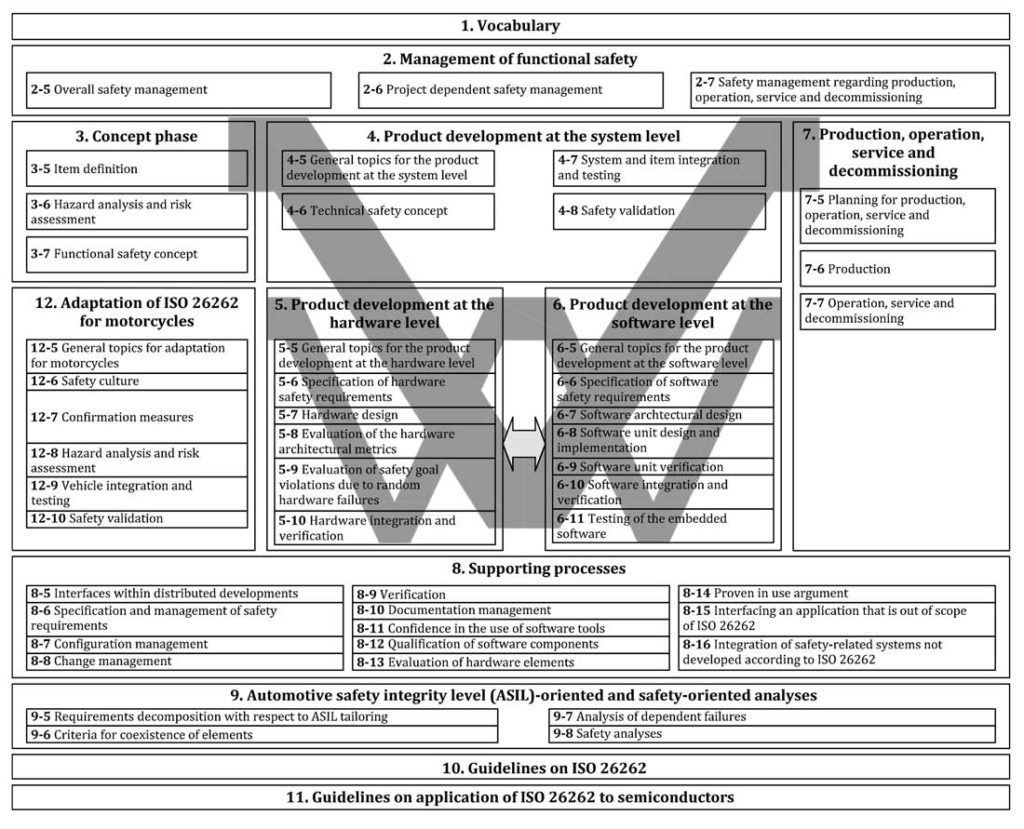
ISO 26262: 2018 is composed of 12 paragraphs
iso26262
Why Has ISO 21434 Become Crucial in Recent Years?
With the rapid increase in vehicle connectivity and the dominance of SDV trends, modern vehicles have essentially become mobile datacenters. ISO 21434 is no longer just a technical framework; it is a mandatory regulatory threshold to align with international cyber regulations like UN R155 / R156. It mandates that enterprises establish rigid TARA (Threat Analysis and Risk Assessment) mechanisms across the product lifecycle and guarantee total software supply chain transparency via SBOM (Software Bill of Materials) management.
In today's market, delivering a product compliant solely with ISO 26262 is insufficient for Tier-1 OEMs. Functional safety and cybersecurity have formed an interdependent symbiosis (Cyber-Safety):
- ISO 26262 Compliant: Ensures the braking system can safely halt the vehicle during an electronic system failure.
- ISO 21434 Non-Compliant: Means a remote hacker could easily breach the system, maliciously overriding safety functions and rendering the brakes useless.
If a product cannot repel cyber threats, even the most sophisticated hardware safety design becomes obsolete. Therefore, iST assists enterprises in anchoring cybersecurity defenses down into the root hardware (HSM / Secure Boot) and the core development pipeline, ensuring connected vehicles possess lifetime resilience against hacking.
iST’s Integrated Safety & Security Verification Solutions
Combining our world-leading semiconductor verification and reliability analysis technologies, iST addresses the two major compliance bottlenecks in automotive electronics:
1. ISO 26262 Functional Safety Solutions
- Full Lifecycle Consulting: Seamlessly aligning with the V-Model from the concept (HARA) phase and system development through software/hardware testing, extending to ISO 21448 (SOTIF) assessments.
- ASIL Level Evaluation: Assisting clients in accurately evaluating technical criteria from ASIL A to D, backed by vital safety analysis support including FMEA, FTA, and DFA.
- Semiconductor & Advanced Packaging Standards: Providing dedicated guidance for SoCs, MCMs, and SiP modules to ensure complex microelectronic components align with mass production and supply chain criteria.
2. ISO 21434 Cybersecurity Solutions
- CSMS & Regulatory Alignment: Assisting enterprises in establishing a robust Cybersecurity Management System (CSMS) to quickly comply with UN R155 and UN R156 international regulatory mandates.
- TARA Threat Analysis & SBOM Management: Executing TARA risk assessments for semiconductor chips and electronic control units (ECUs), and implementing SBOM workflows to secure supply chain software assets.
- Hardware Security & Vulnerability Verification: Validating Hardware Security Modules (HSMs), executing vulnerability scanning, and conducting penetration testing to guarantee architectural resilience against cyber attacks.
The Superiority of iST
- Semiconductor Chip Peripherals (Design & Manufacturing)
- Automotive Electronic Components
- Automotive Electronic Modules (ECUs)
- Automotive Electronic System Products
- Safety-Critical Software
- Semiconductor Industry
- LED Industry
- Optoelectronics Industry
- MEMS Industry
- Other Automotive Electronic Peripheral Sectors
Contact Window | Miss. Chen/Grace | Tel:+886-3-5799909#8916 | Email:web_isd@istgroup.com