
Firsthand industry insights from Asia’s first laboratory to join the AEC as an Associate Member
As cars become supercomputers, is a “Pass” still enough for chip qualification?
When discussing automotive semiconductor reliability, engineers have traditionally asked one familiar question: “Has this IC passed AEC-Q qualification?” But in the era of software-defined vehicles (SDVs) and automotive AI, that question alone is no longer enough.
As vehicle electrical/electronic (E/E) architectures shift from distributed to zonal architectures, functions previously handled by dozens—or even hundreds—of electronic control units (ECUs) are being consolidated onto a small number of high-performance computing (HPC) platforms. For automotive semiconductors, this means much more than fewer ECUs. Automotive AI chips must handle more sensing, processing, and decision-making tasks. Meanwhile, some power devices and electronic components must operate closer to motors, batteries, and powertrain systems.
This creates a demanding combination: chips must process more data and operate for longer periods while potentially enduring high temperatures, high voltages, vibration, and repeated thermal cycling.
As automated driving advances from Level 2 driver assistance toward Levels 3 and 4, LiDAR, radar, cameras, V2X connectivity, and high-definition maps generate large volumes of data. HPC chips must process that data in real time within tight power and thermal budgets.
Automotive semiconductor qualification is therefore expanding beyond whether a single component passes a test. It is becoming a broader reliability engineering effort spanning components, advanced packaging, PCBs, and complete systems.
AEC-Q qualification remains essential, but in the SDV and automotive AI era, it is the starting point—not the finish line.
Does passing AEC-Q mean a device is safe? The hardest problems are those that have not caused a failure yet
One automotive semiconductor risk is particularly difficult to address: a device that works during testing may not remain reliable years later.
Conventional pass/fail electrical testing tells engineers whether a device meets its electrical specifications under defined conditions. However, problems hidden inside packages, material interfaces, and solder joints may not initially appear in electrical measurements. Small cracks, voids, delamination, wire bond defects, or solder joint damage may all be present while a device still functions normally.
After exposure to high temperatures, temperature cycling, vibration, and extended operation in a vehicle, these seemingly minor defects can grow and eventually cause electrical failures.
That is why the pursuit of zero defects requires a broader approach. Engineers must look beyond identifying products that have already failed and ask: “Can we detect the risk before it causes a failure?”
From AEC-Q to Zero Defects: Three Layers of Protection for Automotive Chips
Layer 1: Combine AEC-Q Qualification with DPA to Uncover Hidden Risks
AEC-Q remains one of the most important foundations for qualifying semiconductors for the automotive supply chain. However, the applicable requirements depend on the product.
ICs can be qualified to AEC-Q100, discrete semiconductors to AEC-Q101, discrete optoelectronic devices to AEC-Q102, and MEMS sensors to the applicable AEC-Q103 requirements. Qualification for multi-chip modules (MCMs) can be planned according to AEC-Q104. Products using copper wire bonding also require evaluation against AEC-Q006 requirements for copper wire, bond interfaces, and long-term reliability (Read more: iST AEC-Q Reliability Testing for Automotive Electronics)
As automotive AI and HPC applications integrate more chips into a single package, qualification becomes more challenging. Passing component-level tests is only part of the process.
Once a package is mounted on a PCB, differences in the coefficients of thermal expansion (CTEs) of the package, PCB, and solder joints introduce additional thermomechanical stress. This makes AEC-Q007 board-level reliability (BLR) testing increasingly important. Weibull analysis can also help engineers characterize solder joint failure behavior and estimate reliability life.
AEC-Q qualification asks, “Does the product meet the specified requirements?” Destructive physical analysis (DPA) addresses a different question: “Are there abnormalities that have not caused a failure yet but could become a problem later?”
A DPA workflow can combine nondestructive inspections, such as X-ray and scanning acoustic tomography (SAT), with destructive methods, such as decapsulation and cross-section analysis. Together, these techniques help engineers examine internal die and package structures for cracks, voids, delamination, wire bond defects, and other potential problems.
For automotive products targeting zero defects, the goal extends beyond proving that a device works today. It also involves identifying the conditions that could cause it to fail tomorrow.
Layer 2: If a Chip Fails, How Can the Risk to People Be Reduced?
Reliability qualification evaluates whether a product can operate consistently over time. In automated driving and SDV applications, another question becomes just as important: “If an automotive component fails, can the vehicle remain safe?”
This is one of the central concerns of ISO 26262 functional safety. The focus goes beyond preventing component failures. It includes analyzing potential faults and risks at the system level, then implementing fault detection, diagnostics, safety mechanisms, and degraded operating modes to prevent faults from creating unacceptable hazards.
AEC-Q100 and ISO 26262 therefore serve different purposes. AEC-Q100 primarily addresses IC reliability under automotive operating conditions. ISO 26262 addresses how to control the safety risks associated with faults in vehicle E/E systems and enable the vehicle to maintain or transition to a safe state.
As SDVs depend increasingly on software, connectivity, and over-the-air (OTA) updates, another concern emerges: what if the system is compromised by a cyberattack rather than a component failure? This is the automotive cybersecurity risk addressed by ISO/SAE 21434.
Next-generation automotive semiconductors must therefore help answer three questions: “Will the device remain reliable? Will the system remain safe if it fails? And will it remain secure when connected?”
Layer 3: Zero Defects Requires Control Across the Supply Chain
For a fabless IC design company, chip design is only one part of the process. Wafers may be manufactured by a foundry, while packaging and testing are handled by an outsourced semiconductor assembly and test (OSAT) provider. The finished products then enter Tier 1 and OEM supply chains. A problem at any stage can become a final product quality issue.
Achieving zero defects therefore requires more than adding tests.
The AEC-Q004 Zero Defects Framework provides a foundation for managing quality across the fabless IC supply chain. Methods such as AEC-Q001 Part Average Testing (PAT) and AEC-Q002 Statistical Yield Analysis help identify outlier devices and lots with abnormal yield patterns before they move further downstream.
Manufacturing and supply chain quality can be further supported by IATF 16949 automotive quality management systems, VDA 6.3 process audits, and programs such as IECQ AQP, depending on the company’s role and customer requirements.
There is no single piece of equipment that can detect every possible automotive semiconductor problem.
Instead, the pursuit of zero defects requires a connected approach:
Qualification → Physical Analysis → Functional Safety → Cybersecurity → Supply Chain Quality Management
Each layer helps identify and address risk earlier in the product lifecycle.
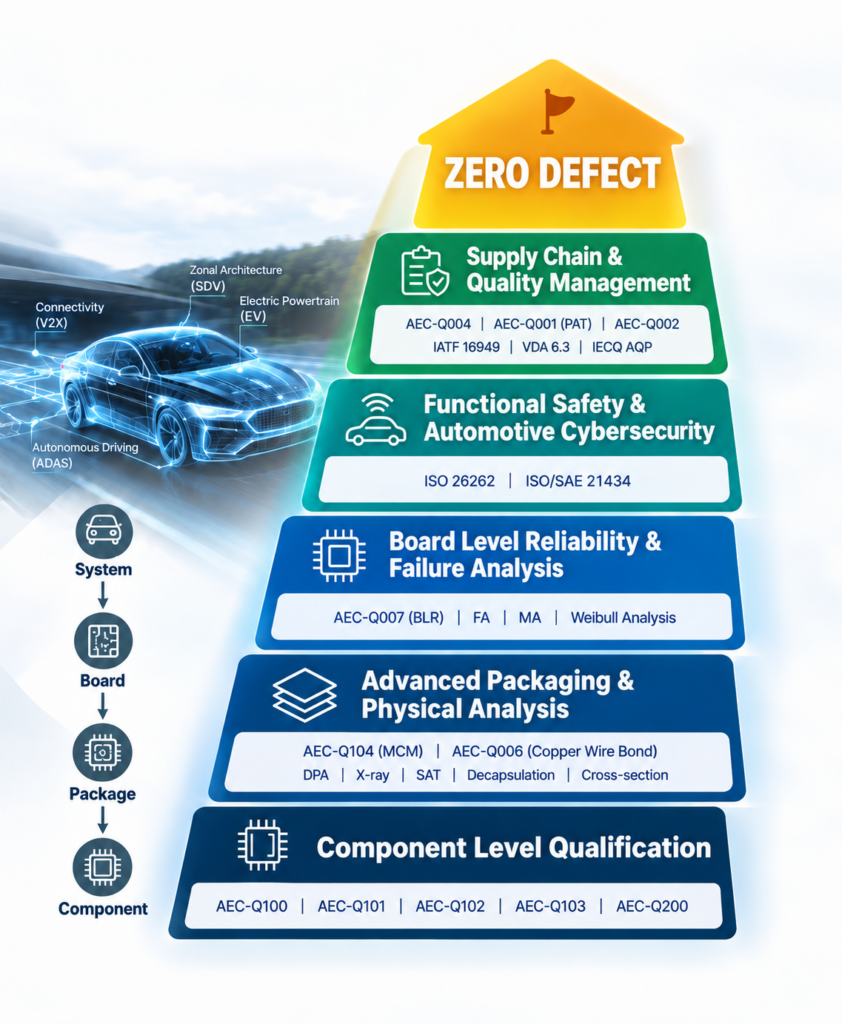
Figure 1: A comprehensive automotive semiconductor qualification framework: From AEC-Q to zero defects.
SDVs and Automotive AI Are Expanding Reliability Engineering from Chips to Systems
Engineers have traditionally asked, “Has this IC passed AEC-Q100?” Increasingly, they must also ask: “What about the package? The solder joints? The PCB? What happens after prolonged operation at high temperatures? And if one function fails, will the overall system remain safe?”
As MCMs, system-in-package (SiP) technologies, and heterogeneous integration become more common in automotive AI and HPC applications, a single package may contain logic ICs, memory, power devices, and multiple material interfaces.
Qualifying the individual chips addresses only one part of the challenge.
Package thermomechanical stress, board-level solder joint reliability, material degradation, thermal management, and failure mechanisms that emerge during long-term operation can all become the next concern.
AEC-Q qualification, DPA, failure analysis (FA), material analysis (MA), BLR, ISO 26262, and quality management should therefore be connected as parts of a continuous automotive semiconductor reliability and risk assessment process.
How Do You Choose an Automotive Semiconductor Qualification Lab? Look Beyond Testing Capability?
The first question when selecting an AEC-Q laboratory is straightforward: “Does the lab have the equipment and capabilities to complete the qualification?”
For automotive products, an equally important question is: “If a test fails, what happens next?”
Can the laboratory locate the failure through failure analysis? Can it use material analysis and DPA to investigate potential material, packaging, or process issues? If the component itself is functioning correctly, can the investigation continue at the board and system levels? When a product is preparing to enter an OEM or Tier 1 supply chain, can the laboratory also support functional safety, cybersecurity, and quality management requirements?
iST began developing its automotive electronics qualification capabilities in 2008. In 2022, it passed the AEC’s review and became Asia’s first laboratory to join the organization as an Associate Member, supporting the work of the AEC Component Technical Committee.
Today, iST provides automotive electronics reliability testing services covering AEC-Q100, AEC-Q101, AEC-Q102, AEC-Q103, AEC-Q104, AEC-Q006, AEC-Q007, and AEC-Q200. Its capabilities also include failure analysis, material analysis, board-level reliability, and consultancy related to ISO 26262, ISO/SAE 21434, and automotive quality management.
For IC design companies, semiconductor manufacturers, and electronic component suppliers preparing to enter the global automotive supply chain, a passing test report is only part of what they need.
The greater value lies in understanding where a product could fail—and addressing that risk before the problem reaches the automaker.
Combining familiarity with requirements from automotive factory, Tier-1, to devices and profound technology based knowledge service to maintain your automotive electronic products
Automotive Semiconductor Qualification: Frequently Asked Questions
Q1. What is AEC-Q, and how do AEC-Q100, Q101, Q102, Q103, and Q104 differ?
AEC-Q is a family of automotive electronic component qualification specifications developed by the Automotive Electronics Council (AEC). Different specifications apply to different product types.
AEC-Q100 covers ICs, AEC-Q101 covers discrete semiconductors, AEC-Q102 covers discrete optoelectronic devices, AEC-Q103 addresses MEMS sensor qualification, and AEC-Q104 covers multi-chip modules (MCMs). AEC-Q006 addresses copper wire bond reliability, while AEC-Q007 focuses on board-level reliability (BLR).
Before starting automotive qualification, suppliers should determine the applicable specifications and qualification plan based on the product type, package structure, operating environment, and target customer requirements.
Q2. Does passing AEC-Q qualification mean a chip can enter an OEM or Tier 1 supply chain?
Not necessarily. AEC-Q qualification is an important reliability requirement for automotive market entry, but it does not mean a product meets every OEM or Tier 1 quality, safety, and supply chain requirement.
Suppliers may also need to address IATF 16949 quality management, ISO 26262 functional safety, ISO/SAE 21434 automotive cybersecurity, and customer-specific requirements.
Fabless IC design companies must also manage process and quality risks at their foundries and OSAT providers. The AEC-Q004 Zero Defects Framework, together with methods such as AEC-Q001 PAT and AEC-Q002 statistical analysis, helps reduce the risk of abnormal products entering the automotive supply chain.
Q3. What is the difference between AEC-Q100 and ISO 26262?
AEC-Q100 asks: “Is this IC reliable enough for automotive use?”
ISO 26262 asks: “If a fault occurs, could it create an unacceptable safety risk?”
AEC-Q100 focuses on reliability qualification for automotive ICs. ISO 26262 addresses the functional safety of road vehicle E/E systems, using a lifecycle approach to manage safety risks associated with malfunctioning behavior.
They address different needs and complement each other.
Q4. Do automotive MCMs, SiPs, and advanced packages require AEC-Q104 qualification?
AEC-Q104 provides qualification requirements for automotive multi-chip modules (MCMs).
As automotive AI, advanced driver assistance systems (ADAS), HPC, and SDVs develop, a single package may integrate logic ICs, memory, power devices, and other components. Thermal, mechanical, and material interface interactions can therefore be more complex than those in conventional single-chip packages.
AEC-Q104 Rev. A updates the qualification requirements for MCMs. When developing automotive MCMs, SiPs, or heterogeneous integration products, suppliers should assess the applicable qualification requirements based on the product structure and intended application.
Q5. Why can a Tier 1 supplier reject a chip that has passed ATE and reliability testing?
Pass/fail electrical testing on automated test equipment (ATE) primarily confirms whether a chip meets its electrical specifications under defined test conditions. It may not reveal every latent physical defect in the package or material structure.
Solder joint cracks, wire bond defects, material interface delamination, and other internal package defects may not cause an immediate electrical abnormality. However, they can develop into failures after temperature cycling, vibration, or extended use.
Depending on product risk, automotive semiconductor suppliers can supplement ATE and reliability testing with DPA, failure analysis (FA), and material analysis (MA) to investigate potential failure mechanisms at the structural and material levels.
Q6. What is DPA, and why is it important for automotive semiconductors?
Destructive physical analysis (DPA) examines a component’s internal structure to identify abnormalities in the die, package, wire bonds, and material interfaces. A typical workflow may include X-ray and SAT inspection before destructive steps such as decapsulation and cross-section analysis.
Its value goes beyond opening a package for inspection. DPA helps reveal physical risks that may be difficult to detect through electrical pass/fail testing alone.
In automotive semiconductors, cracks, voids, delamination, and wire bond defects may initially cause no electrical failure. However, these defects can worsen after prolonged exposure to high temperatures, vibration, or thermal cycling. DPA complements reliability qualification and failure analysis by helping engineers identify potential failure mechanisms earlier.
Q7. What is AEC-Q007, and why do automotive semiconductors need BLR testing?
Passing component-level qualification does not guarantee that a device will remain reliable after being soldered onto a PCB.
The package, PCB, and solder joints contain different materials. During temperature changes, differences in their CTEs generate thermomechanical stress. AEC-Q007 board-level reliability testing evaluates these risks at the board level.
Tests such as temperature cycling, combined with Weibull analysis, help engineers characterize solder joint failure behavior and estimate reliability life.
Q8. How does AEC-Q006 Rev. B affect qualification for automotive copper wire packages?
Copper wire offers electrical conductivity and cost advantages, but its bond interfaces can be affected by oxidation, high-temperature and high-humidity exposure, material reactions, and thermomechanical stress.
AEC-Q006 establishes qualification requirements for automotive semiconductor products using copper wire bonding. Suppliers should review their qualification plans against the applicable revision, product materials, and process conditions rather than simply reuse an earlier test plan.
Q9. How should you choose an AEC-Q qualification laboratory for automotive semiconductors?
Start by asking whether the laboratory can perform the required AEC-Q tests. Then ask: “If a test fails, can you explain why?”
Depending on the product, a comprehensive qualification approach should connect AEC-Q testing with DPA, failure analysis, material analysis, board-level reliability, and support for ISO 26262, ISO/SAE 21434, and automotive quality management.
This helps suppliers move beyond completing individual tests to identifying and reducing the risk of failures after their products enter the automotive supply chain.
Read More
- Automotive Electronic Component Reliability Qualification (AEC-Q)
- Board-Level Reliability (BLR) Testing for Automotive Electronics
- Integrated Consultancy for ISO 26262 Functional Safety and ISO/SAE 21434 Automotive Cybersecurity
- Beyond AEC-Q: Why a “Pass” is No Longer Enough
- The Latest AEC-Q007 Specification Unveils Advanced Board Level Verification for Automotive Applications
- The False Pass Crisis: Why Flawless ATE Data Can Still Lead to Tier 1 Rejections?